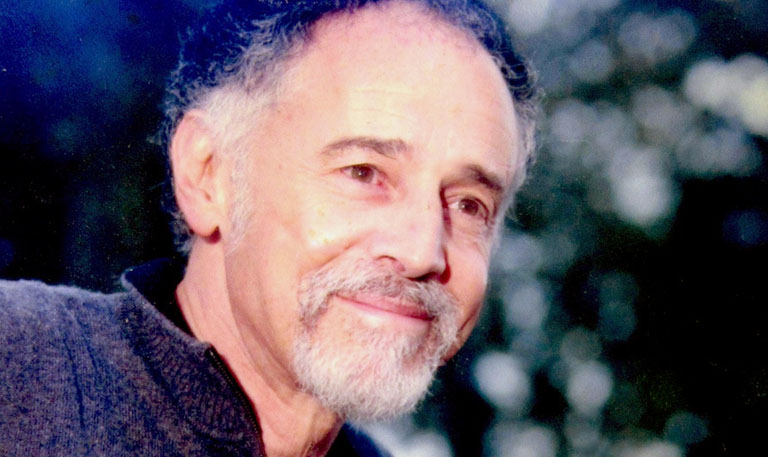


It’s a ritual by now. Every year, in the days leading up to that day, sadness. Not the shallow sadness of a rejected haiku, but a sadness that it sharp, deep, quickly identified. Aryeh’s death day. My brother drowned in Mexico, snorkeling, at age 64. Sixteen years ago.
My younger brother who stepped out of time before me. Since I can no longer measure myself against him, it makes him seem older in a way. Who can be older than someone absorbed by time? Someone who has transcended time?
the lagoon water
brother drowned in
also gone
“We were graduates,” I’d joke, “of the University of Sylvia and Jack.”
The Hirschfield’s were a strangely paired Jewish couple in the West Bronx. She was kind, outgoing, deeply religious. She worked as a bookkeeper. He was a hotel maintenance man, who related to all of us as strangers. More like a boarder than a father, he’d come home from work, greet no one, go directly to his room.
Paternal abandonment forged a bond between Aryeh and I. We’d fantasize about rafting like a couple of Huck Finn’s to some fatherless refuge somewhere. Our bond, however, yielded to the stresses of clashing personalities, family dynamics.
Aryeh was blessed with mom’s outgoing nature, with her gift of drawing people to him. I was, sad to say, his polar opposite. A dark-spirited loner like Dad, I put people off. (If the old man noticed, he kept it to himself.)
The death of family patriarch, Moses Joseph, a Hasid whose extreme orthodoxy rubbed off on Aryeh, pushed our relationship to the edge. I’d be on my way to the park on the Sabbath with bat and ball, when he’d run up behind me, shouting, “God will punish you!” A little Jewish Taliban, who, happily, did not grow up to be a big Jewish Taliban. In fact, he became, in later years, a distinctly open-minded Jewish Renewal rabbi in Oregon (in his study were pictures of Groucho Marx and Ramana Maharshi), a member of Rabbis for Peace.
In our teens, there was a cultural shift. We became art house movie-goers, thrilled by Ingmar Bergman and Vittorio De Sica. We especially loved Bergman’s The Seventh Seal, forever enacting the chess game between death and the crusader, intoning death’s few chiseled lines in English with Swedish accents that made both of us howl.
I miss the laughter of brothers that rose up, it seemed, from the floorboards of our shared bedroom. It closed over the fissures in our relationship, as did our serious talks about Kafka. The suffering of a son permanently estranged from his father. Our story.
It might have been wiser to talk about the alienation of brothers. For when the laughter ended, when our Kafka conversations ceased, my envy of his popularity (reborn after his long season of fanaticism) returned, along with his justified anger over his big brother’s absence of affirmation.
Old age is when we all go for our PhDs in reflection. What a brother is, first of all, is an eruption in time. My first memory is of the day program I went to with my cousin Ruthie, at whose house I was staying when my mother was off giving birth to Aryeh.
At her day care, a dark passageway was constructed against a wall curtained at both ends. We were made to walk through it. Though not normally afraid of the dark, the journey filled me with a primal fear.
Only years later did I realize that that liminal journey in space contained my dread that time was now altered, shadowed by a tiny stranger’s birth. I’d no longer monopolize time. I was condemned to share it.
Like many brothers, we shared it poorly. Like many brothers, we eventually shared it at a distance. In his late teens, he discovered drugs and relocated to San Francisco. I discovered writing and remained in New York for a while, before heading off to South America to find something exotic to write about. We both drifted, but not toward each other.
I awake nights thinking of him. Where, in the unfathomable emptiness that we take to be death, has his spirit found a home? Or is it wandering still? Or am I the one who is still wandering, inwardly and outwardly, from my home to the river, from one haiku to another, toward some elusive center?
It is second nature for an octogenarian to fixate on his losses, having had so many of them. With Aryeh, it was what was lost before his death that haunts me. We would meet on occasion over the years. He’d come in for periodic visits that became frequent when our mother was failing. Or I’d make occasional visits out to the West Coast, where he was working through the various stages of his rabbinical career. Visits that were often intended as pilgrimages of reconciliation.
When we remembered to take deep breaths, there was sharing. Mainly, a mutual interest in the broken state of the world that somehow did not include our relationship. We’d discuss the race question. We couldn’t escape the awareness, even as children, that those hollowed out corpses in striped suits could have been us. Emmett Till, the black 14-year-old Chicago boy lynched in Mississippi in 1955 for allegedly whistling at a white woman, was a victim we could easily identify with. A more complicated identity, especially for Aryeh, were the Palestinians. A rabbi, he was at times prone to giving Israel the benefits of doubts I did not have. But his ability to try to see the occupation through Palestinian eyes when he traveled to the West Bank I held in high regard, as it meant extending himself far more than I had to as a secular progressive Jew.
I keep searching for him in all the old places where his voice can be found, where thoughts were momentarily shared, but never a life shared.
Once, when he was stoned, he said, “I feel like the donkey chasing the carrot. Sometimes I get close. But the carrot is always beyond my reach.”
Chasing after the dead Aryeh is a little like that. The feeling sometimes of getting close. But never close enough.
These words. My skinny candles. Lighted. Doused. Lighted again.
Robert Hirschfield is a New York-based writer and poet. He has spent much of the last five years writing and assembling poems about his mother’s Alzheimer’s. In 2019, Presa Press published a volume of his poems, The Road to Canaan. His work has appeared in Parabola, Tricycle, Spirituality & Health, Sojourners, The Moth (Ireland), Tears in The Fence (UK) and other publications.