

Let’s start with the numbers: According to the Social Security Administration, last year more than 68 million people relied on those federal benefits, including retirees, people with disabilities, children who lose a parent, and surviving spouses. A recent AARP survey shows that 14 percent of people age 65 and over rely on social security benefits for most of their income and an additional 40 percent do for more than half of their income. So, it becomes clear that Social Security, which marks its 90th anniversary this year, is not merely a nice perk. For millions, it’s an absolute necessity.
Two of those people are retirees Sue Luke, 76, and Anne Adams, 80. After long careers paying into the system, they now depend on Social Security for their basic needs.
As a former federal employee, Luke worked for decades at posts all over the country, both as a personnel specialist as well as a writer and editor. “My dad was Navy so I was used to moving around,” she says. An assignment with the U.S. Forest Service in Montana found her assisting scientists who were studying lightning and forest fires. “They were so impressed with my editing skills I got a promotion to technical writer and editor,” Luke says.
Perhaps her favorite job was working for NASA at Edwards Air Force Base. “I think that was the most satisfying. The whole atmosphere was scientific. I edited papers for aeronautical journals and symposiums,” she says.
Eventually retirement called, especially with the birth of a granddaughter. “I moved back to Seattle to spend more time with my family,” says Luke. Because she cashed out her pension to put her son through college, her income now came from one source: Social Security. Looking back, she acknowledges that may not have been the wisest decision. “But I just wanted him to go to a good school, the University of Washington.”
Now she and her cat Goose just make ends meet. “I was able to get into HUD housing in West Seattle,” she says. “And I have SNAP benefits. It’s not much, $25 a month, but at this point, I can do it.”
Fearing inflation will continue to eat into her income, Luke has been looking for editing work she can do at home. “Freelance, part-time. My stamina isn’t great. I do need a nap during the day,” she says, with a laugh. “I’ve been looking for proofreading jobs,” adding that, with artificial intelligence providing more content these days, her skills are needed.
Meanwhile, Luke is grateful for benefits she receives and hopes they aren’t reduced. “For me, Social Security is vital. It means everything to me.”
While some people build nest eggs through their employment, many Americans don’t have that benefit. According to a survey done by The Pew Charitable Trust, almost half of workers in the private sector don’t receive retirement plans through their jobs. Saving on their own can be tough as well when living paycheck to paycheck.
Even though Adams worked for more than 30 years as a registered nurse, there was no pension to fall back on. And as a single parent, she plowed every penny earned into a mortgage and daily expenses.
Born in Canada, Adams grew up on Bainbridge Island near Seattle. It was idyllic, she recalls, with farms and forests. After high school, she crossed the water, taking classes to support a nursing degree. Later, Adams moved to Albuquerque, New Mexico, continuing her studies and earning her degree in 1978.
“I worked long hours in coronary care and surgical intensive care,” she says. In the 1980s, Adams got involved in union organizing for nurses. “After a long struggle we won our first contract and I was hired by the union to help organize nurses in New Mexico and Florida.” Eventually, Adams returned to nursing. “It was challenging and intense but I loved it,” she says. Working at a public hospital was especially rewarding. “I enjoyed helping folks who were pretty bad off financially.”
Now she finds her own finances strained. Without a pension, Adams depends on monthly Social Security checks. “My mortgage takes up some of it and the rest goes for food, utilities, medical, the usual things,” she says. It helps that Albuquerque is fairly affordable, but if her benefits were reduced, she’s not sure what she’d do.
Luke, Adams and the other 68 million people who rely on Social Security are why the safety net was created 90 years ago. Yet, shortfalls are predicted to reduce benefits within seven years if Congress doesn’t act. “I just hope Social Security continues to be there,” Adams says. “Not just for people like me, but also for our kids and grandkids.”
Essential and Earned: Ninety years of Social Security
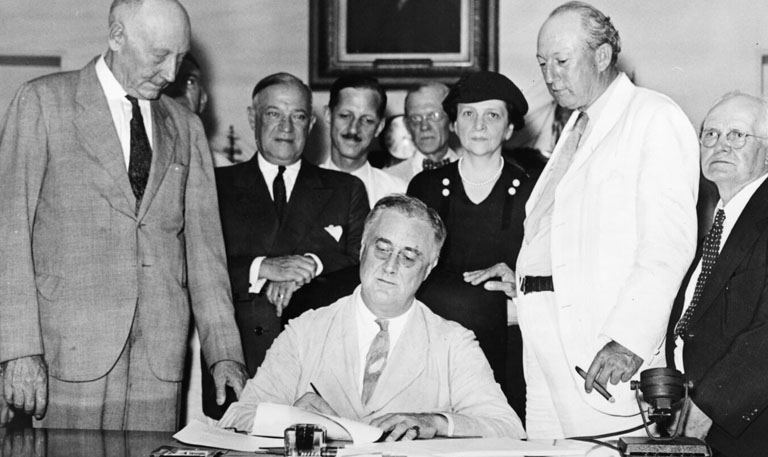
On August 14, 1935, President Franklin D. Roosevelt signed the Social Security Act into law, a form of insurance that workers pay into and distinct from a social welfare program. “We can never insure 100 percent of the population against 100 percent of the hazards and vicissitudes of life,” Roosevelt said, “but we have tried to frame a law which will give some measure of protection to the average citizen and to his family against the loss of a job and against poverty-ridden old age.”
Over the years, Social Security expanded its safety net to include children who have lost a parent, people with disabilities, as well as surviving spouses. As Roosevelt pointed out, the program is not a handout. It’s insurance, there when needed, paid for with every paycheck earned throughout working years. But what about the future? While experts say that Social Security is not going away, a funding shortfall does loom. The nonprofit, non-partisan Committee for a Responsible Federal Budget recently estimated a 24 percent cut to Social Security by the end of 2032 if Congress fails to act.
Roosevelt could not have known about these current issues but he understood there would be challenges. In a speech commemorating the third anniversary of the Social Security Act, he gave a radio address to the nation, offering this caution:
“I am hopeful that … Congress will improve and extend the law [. . .]. One word of warning, however. In our efforts to provide security for all of the American people, let us not allow ourselves to be misled by those who advocate short cuts to the utopia of fantastic financial schemes.
“We have come a long way. But we still have a long way to go. There is still today a frontier that remains unconquered—an America unclaimed. This is the great, the nationwide frontier of insecurity, of human want and fear. This is the frontier—the America—we have set ourselves to reclaim.”
Protecting Social Security’s Legacy and Future
This year marks a powerful milestone—90 years of Social Security. Since President Franklin D. Roosevelt signed it into law on August 14, 1935, Social Security has been a cornerstone of economic security, ensuring Washingtonians can retire with dignity, supporting people with disabilities, and providing vital income after the loss of a loved one.
Over the past nine decades, not a single payment has been missed. That’s not just reliability—it’s a testament to the strength and success of one of America’s most trusted institutions. We’ve all paid into it. We all depend on it. And we must all fight to protect it.
Today, more than 1.4 million Washingtonians rely on Social Security. For many, it’s the difference between stability and hardship—covering rent, groceries, prescriptions, and basic needs. Without it, nearly 314,000 residents would fall below the poverty line.
Despite its success, Social Security is under pressure. Across Washington and the nation, people face long wait times, understaffed offices, and confusing policy changes that make it harder for individuals to access benefits they have rightfully earned.
As we mark 90 years of strength and shared commitment, let’s stand together to protect Social Security. Learn more and get involved at aarp.org/socialsecurity.
This story was made possible by funding support from AARP Washington. Learn more and get involved at aarp.org/wa