

Poseidon was restless and the Ionian Sea rough. The boat surged and plummeted, slamming our beds up and down and side to side. Even in calmer water, we all lurched across the dining room and grabbed at handrails on the slippery staircases. An apt metaphor for fragility and balance, especially when navigating this particular life stage. A member of the sandwich generation no more. Instead, I’m now a mother without a mother.
On the first anniversary of my mother’s death, I was traveling on a small ship in Greece, motoring the last leg from Crete to Hydra. I’d booked the trip because I needed to keep moving and exploring to hold the aching sadness of the past year at bay. A year of remembering my mother’s long and vigorous life—and at the same time, fighting off memories of her last days and excruciating death. People should not have to be in charge of dosing their mother with morphine until her body finally gives out.
But I’m not a wallower. I tend to get busy when the going gets rough and feelings get tough. Staying home, stuck in my routines, my ongoing “organ recitals” with friends, and worries about daily responsibilities, felt stifling. I set out on this trip hoping for distraction, but I also sought time to reflect and remember her, preferably in the close vicinity of others, who are not family, and around whom I would be less likely to crumple into tears.
My mother and grandmother took me on my first international trip when I was 23. In our rental car, reminding whoever was driving to stay on the left side of the road, we explored England and Scotland for a couple of weeks, even meeting the British pen pal I’d been writing to since the seventh grade. One day, climbing up the steeple of a church, my mother and I peered down at the park below where my grandmother sat on a bench waiting for us. I shouted down, “Hello Grandma!” and we laughed when a half-dozen gray heads lifted at the call. One morning, when Grandma slipped a breakfast roll from the bed and breakfast into her pocketbook “for later” and explained that all the folks on the AARP trips did this, we followed her lead. We came to call it “AARPing” food to snack on while sightseeing.
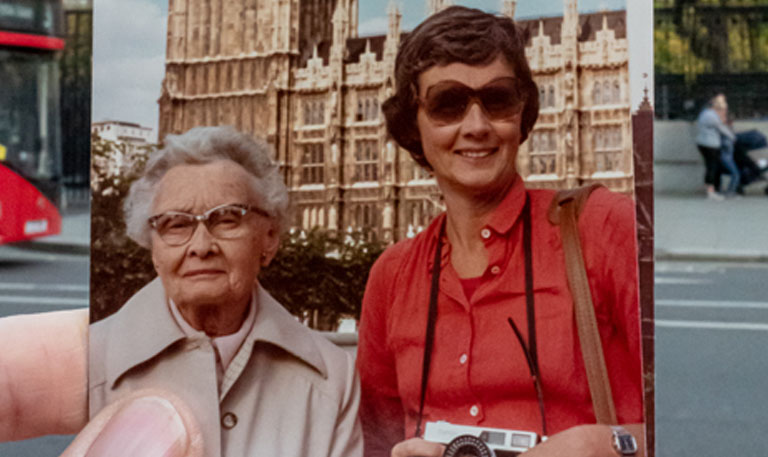
My grandmother died at 94, just before my first child was born. A career and raising kids took over my life and traveling was planned around hubs like Disneyland, Legoland and the San Diego Zoo. Finally, after I retired, I treated myself to a river cruise in Europe and the travel bug sprung from its cocoon. When my mother was still alive but no longer traveling, I visited London again, this time on my own. When I reached the park across from Big Ben, I pulled out a snapshot of her and my grandmother and found the same spot from which I’d taken it all those years before. I lined up the tower of Big Ben with the old snapshot and photographed both, superimposing an image that would help keep the two most important women in my life close to me.
A few months after my mother’s death, I was changing planes in London and there in Heathrow I was stung by the permanence of their absence. In the hustle and din of the airport though, it was a quiet thought, a tiny stab of sorrow. I acknowledged it and trusted that those stabs would continue to soften over time. Before I left the lounge for my connecting flight, I AARPed a scone and jam, a banana and a granola bar for the next leg of my journey. Thanks, Grandma.
I booked the Greece trip as part of a need to surround myself with people on the first holidays without my mother. I’d hiked with friends on her birthday and spent the fall and winter holidays with my sons. So that I wouldn’t languish at home on the first anniversary of her death, I hoped that being with a group of travel companions would keep me preoccupied and entertained, bump my mind over to another, lighter track.
And it did. My new travel mates, most of them older than me, shook me out of my mid-60s slump and my gloomy self-talk about the pains and indignities of my own aging. They unfolded their walking sticks, slipped on knee braces, and in one case fell off the gangway into the Mykonos harbor, but they all kept going. Pushing ahead, just the way my grandmother and mother did until the end of their lives.
It had been a year of firsts. First time driving by my mother’s house without her in it. A sushi order without her favorites. My birthday celebration without the woman who birthed me. And it had been a year of lasts. The last time we would see her furniture before it was carted away. The last time we would pick blueberries in her yard before the house sold. The last time I would use the house key to unlock her door to say goodbye to her space, the place we gathered as a family, the place where she died in front of a picture window out of which she could no longer see.
I’d mentioned the first anniversary to two women early in the trip, and both checked in with me on the day. I choked up briefly when I replied, but I was able to tell the truth. “It’s getting better.” Then, our talk turned to the calmer weather expected on Hydra and I felt solace. Unless we go first, we all lose our mothers. Only the gods have eternal life.
Katherine Briccetti is a Pushcart-nominated essayist and author of the memoir, Blood Strangers, a LAMBDA Literary Award Finalist. Her writing has appeared in Dos Passos Review, Short ´Edition, Sojourn: A Journal of the Arts, Under the Sun, upstreet, The Writer, Bark, Los Angeles Times and several national anthologies. She earned an MFA in Creative Writing from Stonecoast in 2007. She is at work on a novel about race and relationships, which takes place in the middle of America in 1968. www.katherine.briccetti.com